Hardcoded Secret Detection Across Enterprise Repository Portfolios
Internal repos harbor six times more hardcoded secrets than public ones.
Enterprise secret sprawl is a coverage and remediation problem, and it gets worse every time repository count climbs. A pre-commit hook on a single repo can stop a developer from committing an AWS key by accident, but it does nothing for the four-year-old repo nobody has touched since a product got sunset, or the credential sitting in a Jira ticket from an incident postmortem years ago. Treating this purely as a discipline issue, install a hook, tell people not to paste keys into code, breaks down once an organization crosses into thousands of repositories: teams that lead with commit-time hygiene are solving the smallest part of the problem first.
That model works fine for a ten-person startup with one repo. It falls apart once an organization runs thousands of repositories across multiple source control platforms, with git histories going back a decade and ownership records nobody has touched since the last reorg. Several things break simultaneously at that scale. A meaningful share of codebases go untouched for months or years, so whatever scanning policy exists today didn't exist when those repos were active. Most large organizations also run more than one source control platform, GitHub for some teams, GitLab or Bitbucket for others, Azure DevOps for a legacy division, and no single platform-native scanner reaches across all of them. It takes exactly one ungoverned repo in a forgotten product line to expose a credential shared across the entire infrastructure; a leaked CI/CD token or cloud IAM key doesn't respect repo boundaries, it grants access wherever that credential is trusted, which is frequently well outside the four walls of the repo where someone found it.
The assumption that internal repos are safer than public ones does not survive contact with the numbers. Per GitGuardian's research, 32.2% of internal repos contain at least one hardcoded secret, against 5.6% of public repos, a gap running the wrong way by nearly six times. AWS IAM keys turn up in 8% of private repositories, a notably higher rate than in public code. The reason isn't mysterious: private repos get less scrutiny because nobody expects outsiders to see them, developers treat obscurity as a substitute for actual protection, and enterprise tooling decisions get made around the flagship codebase, leaving legacy services uncovered by any scanner at all. What follows works through the accumulation mechanisms, the remediation lag, the coverage gaps, and the layered stack that closes them at real enterprise scale.
Git history behaves like a time capsule. A secret committed and then deleted three years later still sits in every clone of that repo, in every fork, in every backup. Deleting a line from HEAD doesn't remove it from the object database; anyone with clone access can walk the commit log and pull the credential straight out of history. This one fact undermines a lot of naive remediation, where a team sees a secret, deletes it from the current file, closes the ticket, and never rotates the credential underneath it.
Ordinary developer habits feed the pile just as much as any single bad actor. Local .env files get promoted into shared repos during an incident, when someone needs a fix out fast and skips the usual review. Credentials get hardcoded "just to test something quickly" and never come back out, because nobody schedules the cleanup. Copy-pasting a credential across a dozen microservice repos turns one exposure event into a dozen codebases at risk instead of one. Terraform files and Helm charts routinely embed secrets inline, since infrastructure-as-code often gets treated as configuration rather than code that needs the same scrutiny as anything else.
AI coding tools have become a structural accelerant on top of all this. AI coding tools introduce patterns that can bypass the friction pre-commit hooks depend on, and AI-generated code can inherit insecure patterns baked into its training data; agents optimizing for speed route around the checks that would otherwise catch mistakes before they land. LLM API keys have become one of the fastest-growing categories of leaked credential in their own right: GitGuardian detected 1,275,105 leaked secrets tied to AI services in 2025, an 81% jump from 2024, and AI-service credentials ranked among the fastest-growing categories of leaked secret types.
None of this stays confined to code, either. GitGuardian found that 28% of incidents in 2025 originated entirely outside source code, in Slack, Jira, Confluence, and similar tools. The ratios show how thin coverage gets: roughly one secret turns up in ticketing systems for every 42 found in code, and one in messaging platforms for every nine in code. At portfolio scale those ratios compound fast, since every team runs its own Slack channels and its own Jira projects, and most scanning programs never touch either.
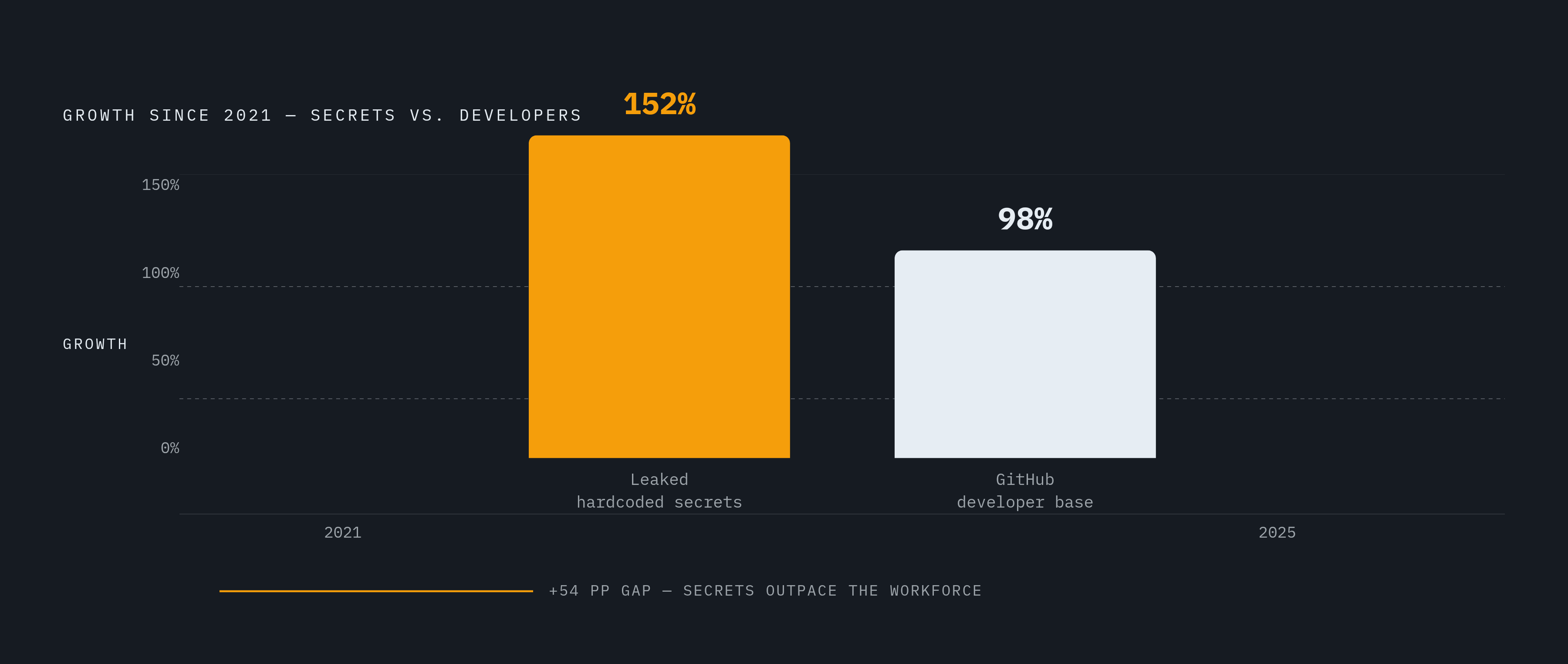
The overall trend line is not flattening, and assuming this problem will plateau on its own is a second costly mistake. GitGuardian found 29 million new hardcoded secrets on public GitHub alone in 2025, a 34% year-over-year increase, the largest single-year jump on record. Leaked secrets have grown 152% since 2021 while the GitHub developer base grew 98%. Secrets are piling up faster than developers are joining the platform.
Why detection alone does not close the exposure window — the remediation lag problem
Finding a secret and fixing a secret are two different events, and most of the actual risk lives in the gap between them. As of January 2026, 64% of secrets confirmed valid back in 2022 were still valid, still exploitable, meaning four years of sitting exposed in public code with nobody rotating the credential behind them. Detection tooling did its job in those cases. Nothing downstream of it did.
The reasons rotation lags even when detection works exactly as designed are organizational rather than technical, and that's the part many security teams overlook when they buy another scanner instead of fixing the handoff. Alerts get routed to a security team that doesn't own the credential and has no unilateral authority to rotate it. Repos tied to departed engineers or dissolved teams have no clear owner at all, so the alert sits in a queue with nobody to act on it. Engineers hesitate to rotate a credential that might still be powering a production service they don't fully understand, since breaking something live feels worse, in the moment, than leaving a known exposure in place. Once alert volume climbs into the thousands, triage itself becomes the bottleneck, well before anyone even gets to remediation capacity.
Generic secrets make the backlog worse. GitGuardian's 2025 research found 58% of all detected secrets are now generic, meaning passwords and tokens with no standardized prefix a scanner can recognize on sight. Generic secrets show up eight times more often in private repos than public ones, and they slip past automated filters tuned to known credential formats. That means they sit undetected longer, and when they finally surface, the backlog behind them is worse than it would be for a well-formatted, easily pattern-matched key.
The consequences are not abstract. The 2024 U.S. Treasury breach traced back to a leaked API key for a third-party authentication platform; no zero-day, just one exposed credential sitting there long enough for someone to use it. The average cost of a data breach in 2025 runs $4.4 million. Any program that deploys scanning without first building remediation workflows, ownership assignment, and rotation playbooks ends up with a long, accurate, and completely unmanageable list of problems it cannot act on. Detection produces a number that goes up. Remediation is a separate number, and it needs its own owner, its own budget, and its own tracking, or it never moves.
The detection coverage problem: why no single tool scans everything an enterprise needs
Running one scanner and assuming full coverage is a mistake the data does not support. Academic benchmarks show only 18 to 76% overlap between different scanners' true-positive sets, so picking a single tool, however good, still leaves a meaningful share of real secrets sitting undetected.
Secrets show up across four distinct surfaces, and each calls for a different detection approach; there's no shortcut around running more than one tool. Pre-commit scanning stops a secret before it reaches a server. CI/CD scanning catches what slips past a local hook once a pull request or merge pipeline runs. Historical git-history scanning surfaces secrets committed years before any scanning policy existed. Non-code collaboration tools, Slack, Jira, Confluence, are increasingly where validated incidents actually originate, and where they get discussed after the fact.
Platform-native scanning only solves part of this, and treating it as sufficient is where a lot of enterprise programs quietly fail. GitHub's native secret scanning and code security features apply to repos hosted on GitHub; an organization running GitLab, Bitbucket, or Azure DevOps in parallel gets zero coverage on those platforms from that tool, full stop. Native tools also tend to be strong on specific, known-pattern credentials, AWS keys, Stripe tokens, and weaker on generic secrets, which happen to be the fastest-growing category. Per-committer subscription pricing stacks up fast once an organization needs both secret scanning and code security across a large engineering headcount.
There's a gap most enterprise programs don't even think to look for: the developer endpoint itself. Secrets sitting in local .env files, cloud credential configs, or AI agent context files never touch a repo or a CI pipeline, so they stay invisible to every commit-time scanner in the stack. That's probably the most overlooked exposure layer in enterprise programs, because it lives entirely outside the git-based mental model most secret-scanning tooling was built around. No single tool closes all four gaps at once. Assembling coverage that does is the actual engineering problem.
Open-source scanners and where each fits in a portfolio-scale program
Gitleaks is the workhorse for the pre-commit and CI layer. It's MIT-licensed, it's the fastest open-source scanner available, and it runs sub-second on a typical diff. The right deployment pattern puts Gitleaks on every developer workstation as a pre-commit hook, and again in CI on every pull request as a backstop for anyone who skipped or disabled the local hook. Its strength is zero friction at the blocking gate. Its weakness is that it has no credential verification, so it can't tell a live AWS key from one rotated out six months ago, which matters a great deal once a team is trying to prioritize a backlog instead of treating every finding the same. At portfolio scale, the real challenge with Gitleaks isn't the tool; it's enforcing hook installation across every repo an organization owns, which is a governance problem wearing a tooling costume.
TruffleHog covers the historical scan and verification layer Gitleaks doesn't touch. It's an AGPL-3.0 CLI that scans git history, file systems, S3 buckets, and CI/CD environments, combining regex pattern matching with entropy analysis to catch things that don't match a known format. Its verifier modules validate more than 700 secret types using safe, read-only API calls, distinguishing a live credential from an expired one. That distinction matters enormously for any team trying to triage years of accumulated history without treating every finding as equally urgent. The typical pattern is a scheduled weekly full-history scan across the entire repo portfolio, surfacing secrets that predate the scanning program entirely. TruffleHog Enterprise, the commercial version, adds centralized dashboards, SSO, and role-based access control for organizations that need governance on top of the open-source engine.
Detect-secrets, built by Yelp, solves a narrower but genuinely useful problem: noise. It maintains a baseline file of secrets a team has already acknowledged, so developers only get alerted to genuinely new findings instead of re-triggering on the same backlog every scan. It fits best as a supplementary pre-commit layer for teams sitting on a known, already-triaged backlog who want ongoing scanning without relitigating old findings every week.
Entropy analysis is a capability, not a single tool, and it shows up across several of these scanners. High-randomness string detection catches tokens and private keys that don't match any known pattern, the only real defense against the generic secrets problem. The trade-off is a higher false-positive rate than straightforward pattern matching, so entropy-based findings need filtering or verification before they land in a live alert queue; skip that step and they just add noise on top of an already noisy problem.
When managed platforms and self-hosted enterprise tools become necessary
Open-source tooling covers detection well. It doesn't cover what happens after detection, and at portfolio scale that gap is the actual constraint. Centralized visibility across thousands of repos, aggregated dashboards, and audit trails a compliance team can actually use are capabilities Gitleaks and TruffleHog leave to other layers of the stack. So is automated ownership routing, the mechanism that gets an alert to the right engineer without a human manually tracing repo ownership every time. Honeytoken deployment, planting fake credentials to catch theft in progress, continuous monitoring of public surfaces for secrets that originated inside the organization, and compliance reporting for SOC 2 or ISO 27001, all sit above the open-source layer.
GitGuardian is the clearest example of what a managed platform adds. Its ML-based filtering brings false-positive rates down to 1 to 3%, which matters enormously once alerts span thousands of repos rather than one. It offers real-time monitoring of public GitHub for secrets tied back to the organization, something no open-source tool attempts at that scale, along with rotation playbooks and honeytoken capabilities that push the platform past detection into active response. The trade-off is straightforward: a SaaS platform means code metadata and secret context leave the organization's environment for a third-party cloud, a real problem for enterprises with strict data residency rules or air-gap requirements that make any external data flow a non-starter.
For those enterprises, financial services, defense, healthcare, sending repository content or credential metadata to an external SaaS is often simply not permitted, no matter how good the platform is. Self-hosted deployment, whether TruffleHog Enterprise or an equivalent, keeps every finding inside the organization's own environment end to end. For a regulated enterprise, self-hosted is often the only compliant path rather than a fallback preference. Code intelligence platforms deployed inside an organization's own infrastructure can serve double duty here: cross-repo search built for code understanding doubles as the query layer for finding where a specific credential pattern shows up across an entire portfolio, without any of that search traffic leaving the network.
Detection and secrets management are different jobs, and the distinction is worth keeping sharp. Detection finds secrets that already exist in the codebase. A vault layer stops new ones from getting hardcoded in the first place. HashiCorp Vault is the established enterprise standard, offering dynamic secrets with automatic expiration across more than 50 supported systems; HashiCorp itself was acquired by IBM in 2025. Infisical is a practical open-source alternative, MIT-licensed and self-hostable on Postgres and Redis, with no proprietary cluster to stand up, a reasonable fit for teams that want self-hosted vault capability without enterprise licensing overhead.
Designing a layered detection stack that scales to thousands of repositories without creating alert overload
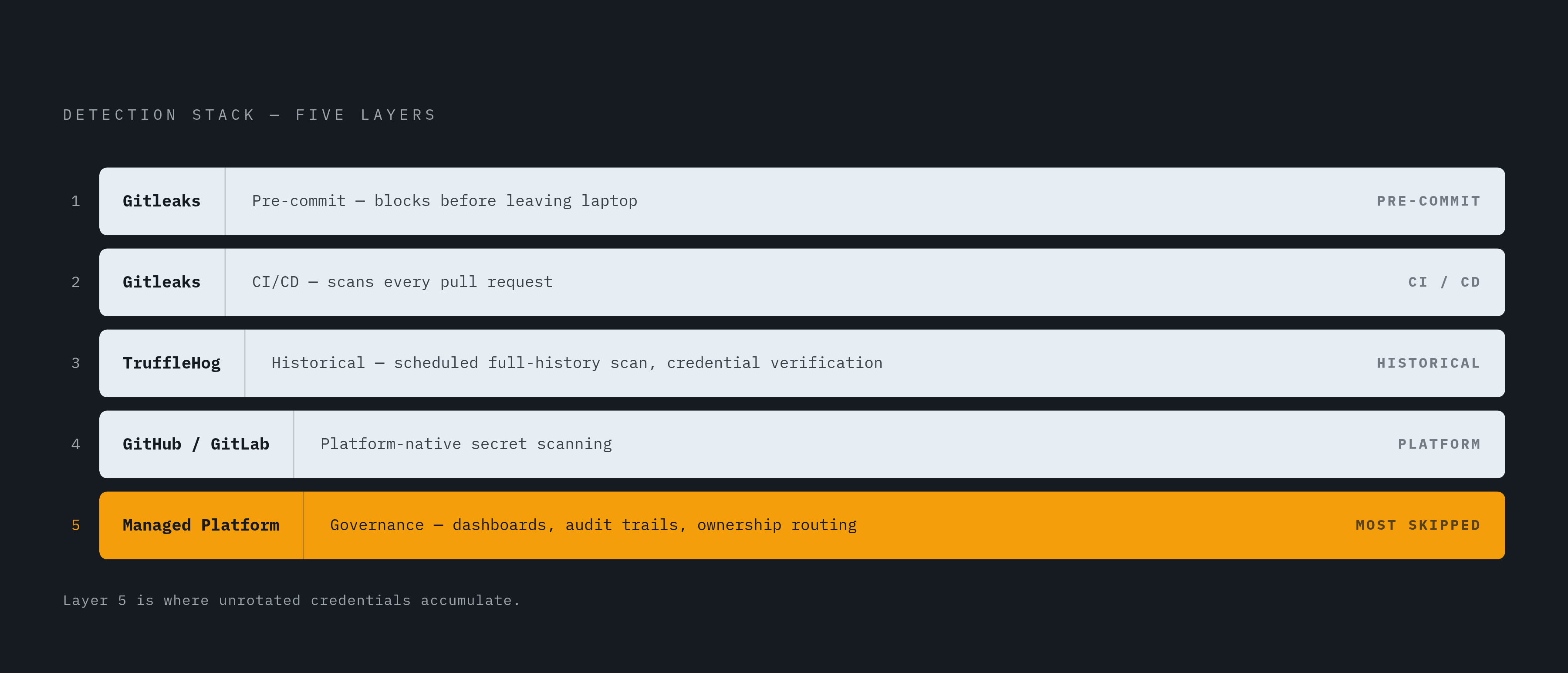
Practitioner consensus heading into 2026 settles on five layers working together, and any program that skips a layer to save money will end up paying for it in unrotated credentials later. Layer one is pre-commit: Gitleaks on every developer workstation, blocking secrets before they leave a laptop. Layer two is CI/CD: Gitleaks again, on every pull request, catching whatever slipped past a disabled or missing local hook. Layer three is historical: TruffleHog running a scheduled full-history scan across the portfolio, with credential verification separating live secrets from ones already rotated. Layer four is platform native: GitHub Secret Scanning or GitLab Secret Detection as a safety net at the SCM layer. Layer five is governance: a managed platform, or a self-hosted equivalent where compliance demands it, providing centralized dashboards, audit trails, and ownership routing.
None of this matters if the alert volume overwhelms the team meant to act on it. Raw scanner output across a large portfolio produces findings in the thousands, and triaging every one by hand isn't realistic for a security team of normal size. Verification-first prioritization is the fix: route verified, live credentials for immediate action, and queue unverified or already-expired findings for batch review instead of treating everything as equally urgent. Severity should track credential type as well as presence; cloud IAM keys, CI/CD tokens, and database passwords get P1 routing, while generic low-entropy matches sit lower until someone has time to look. None of this works without ownership assignment built into the process from day one, since an alert with no identified owner just stalls indefinitely. Repos need a declared owner in a registry the alerting system can actually query, not a spreadsheet someone updated two reorgs ago.
Cross-repo search earns its place as an investigation layer once a credential turns up somewhere. The immediate question after any finding is where else that same credential appears, and regex or structural code search across the full portfolio answers that in seconds instead of the hours it takes asking engineers to check manually, repo by repo. A self-hosted code intelligence platform with that search capability lets a security team scope the actual blast radius of a finding without depending on tribal knowledge of who owns what. The same infrastructure supports hunting proactively, too: querying for known environment variable names, key prefixes, or configuration file patterns across the entire portfolio before any scanner flags them, instead of waiting for the next scheduled scan to surface what's already sitting there.